Showing posts with label Science. Show all posts

Wednesday, March 5, 2014

Hypnosis and Brain Waves

In order to understand how Hypnosis works, one must first gain an understanding of thoughts,
and their importance in how they influence our decisions on a day to day basis. 
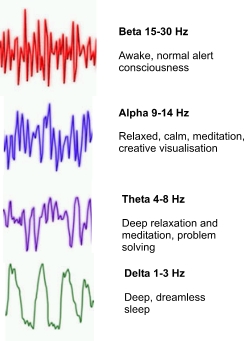
There are 4 types of brain waves, listed below. (Beta, Alpha, Theta, and Delta):
 Every thought is electric.
We can measure the electrical activity that goes on in the brain using an EEG machine, in cycles per second.
Next to each of the brain waves listed above, is a number in Hz. This is representative of cycles per second; or, in other words, how frequent our thoughts are occurring; how frequent our neurons are firing per second. 

The subconscious mind (which is present during hypnosis) is activated in the Alpha, Theta, and Delta states, where thoughts are less frequent. 

On the other hand, our conscious mind is in Beta. 
This is where our thoughts are going fast-paced, usually when we're stressed or agitated, or even taking a test, where we need to be concentrated on something that requires a lot of our attention. This is where we typically function throughout the day. It is in Beta brainwave function where we experience EGO. Our egos resist changes in our behavior. This is why the key to hypnosis, is to relax brainwave function to a slower state, in order to bypass the resistance of one's ego during Beta brainwave function.

The moment we enter an Alpha state, where our thoughts are slightly less frequent, this is a light hypnotic state. Our subconscious is present, yet our conscious mind is still somewhat active here, as we are still aware of what's going on around us. However, in an alpha state, we are able to bypass the ego. Many of us slip in and out of this state multiple times a day quite naturally, such as when we dream, daydream, watch TV, read, or even drive a familiar route. On average, we spend about 4 hours per day in the alpha brainwave state. 95% of people can achieve this state, at will, during a hypnosis session.

Once our mind enters into a Theta state, at 4-7 cycles per second, images begin to form, and it is as though our conscious mind is taking a complete rest, and allowing the subconscious to take over. This is a state of complete and total relaxation. On average, 70% of hypnosis subjects achieve the Theta state. It is in this state where one experiences amnesia, and may have faded memories of the hypnosis session.

Finally, the Delta brainwave state corresponds to our deep sleep state, also known as REM (rapid eye movement) sleep. We spend an average of 3 hours per night in this state. Delta functions between .05-3.5 cycles per second, and in this state, we are completely unconscious, and don't have any memories of what has happened in and around us during this time. Only about 5% of hypnosis subjects will slip into this somnambulist state during a hypnosis session.

Here is an interesting video about how to achieve your goals with intention by entering the most ideal brainwave state to set and achieve them:


Monday, February 24, 2014

The Vagus Nerve


One of the most fascinating new topics I have come across recently is the Vagus Nerve. This nerve is known as the "wanderer," rightfully so, as it wanders throughout our upper body, beginning at the top of our brain stem, going down our neck and connecting our brain with our heart, lungs, and digestive system. There are billions of neurons within the Vagus Nerve that are responsible for communication between these key organs within our body.

The Vagus Nerve is part of the autonomic nervous system, which is the system that controls the automatic functions of our body (breathing, heart rate, digestive system, hormones), the things we don't do on a conscious level. 

The autonomic system has two different branches: the sympathetic and parasympathetic. They work together as one; the sympathetic is the accelerator of the body, while the parasympathetic can be thought of as the brakes of the body. The following is an example of how the two branches work together: The sympathetic nervous system makes sure that our heart rate elevates when we inhale. Inhalation is an action, our body is ready for action when we breathe in. The other branch, the parasympathetic, makes sure that our heart rate slows down when we exhale. It is responsible for relaxing and slowing down the body. If we can control that part of our nervous system in our daily life, we will be able to control our reactions to situations that we come across.

The Vagus Nerve is very responsible for the communication that goes on between our heart and our brain. When our eyes perceive a stressful situation, they tell our brain, "we're in a stressful situation"; then our brain tells our heart, and then our heart rate elevates. Then, our heart rate sends a message back to our brain saying, "get ready, we're in a stressful situation." The heart, through its rate, sends a signal to the brain. The message that goes from our heart to our brain has a tremendous effect on how we perceive a situation we're in, as well as how we're going to react to it. 

Imagine if you were to be able to consciously control the message that goes from your brain to your heart, as well as your heart to your brain. You consciously control your reaction and perception of every situation you find yourself in.

Our heart continuously tells our brain how we feel at each moment.

If we control the messages that our heart is sending to our brain, we can control the way we function in daily life. Scientists say that our Vagus Nerve has a tone (just like a muscle can have a stronger or weaker tone, our Vagus Nerve can also be strengthened the more we use it). People with a high Vagus Nerve tonality are better able to relax when encountering a stressful situation, have a greater sense of well-being, as well as stronger relationships. It has also been shown that those with a high functioning Vagus Nerve have a stronger immune system response, as the nerve regulates the body's inflammation response to disease.

Here is a way to strengthen your Vagus Nerve:

1) Breathing: The elevation and slowing down of our breathing and heart rate, if it is at an even, rhythmic pace, there is a greater level of coherence in the communication between our heart and brain. By becoming mindful of your breathing, your body will automatically relax, as your brain goes into an alpha state.
2) Combining breathing with feelings of Love, Compassion, and Gratitute in your heart. Feelings of compassion and love strengthen the tone of your Vagus Nerve.

The Vagus Nerve can be considered as our interface with the world. As we perceive, our thoughts about what we are perceiving get passed around via the Vagus Nerve to all parts of our body, telling our body how to respond based upon what we are perceiving. 

The fascinating part is that the Vagus Nerve is also connected to our digestive system, and whatever we put into our stomachs sends a signal from our gut to our brain and our gut to our heart. That is why eating habits are so very important to your state of mind and state of well being. When we perceive that we're in a stressful situation, our Vagus Nerve slows down our digestive system, as the Fight/Flight response [sympathetic nervous system] is activated. So, in learning how to better respond to stressful situations, you are also in turn improving your digestive system. Chew on that!

Here's some interesting videos:


Visit my home page for more information about me and hypnotherapy:
http://www.sarahjondreau.com